


The East Bay housing market is undergoing a quiet but meaningful transformation in 2026.
For years, Fremont has been the go-to destination for Silicon Valley professionals seeking suburban comfort with strong schools and manageable commutes.
But as home prices have continued their upward climb, even well-qualified buyers are starting to feel priced out of the neighborhoods they once targeted.
That pressure has sparked a noticeable migration pattern—one that’s not about leaving opportunity behind, but rather repositioning for smarter value.
Just a few miles south, Milpitas is stepping into the spotlight, offering a compelling blend of accessibility, modern housing, and commuter convenience.
For many buyers, especially young families and dual-income tech households, the decision is becoming increasingly clear: it’s time to seriously consider moving from Fremont to Milpitas.
What Is Driving the Santa Clara County Market Shift
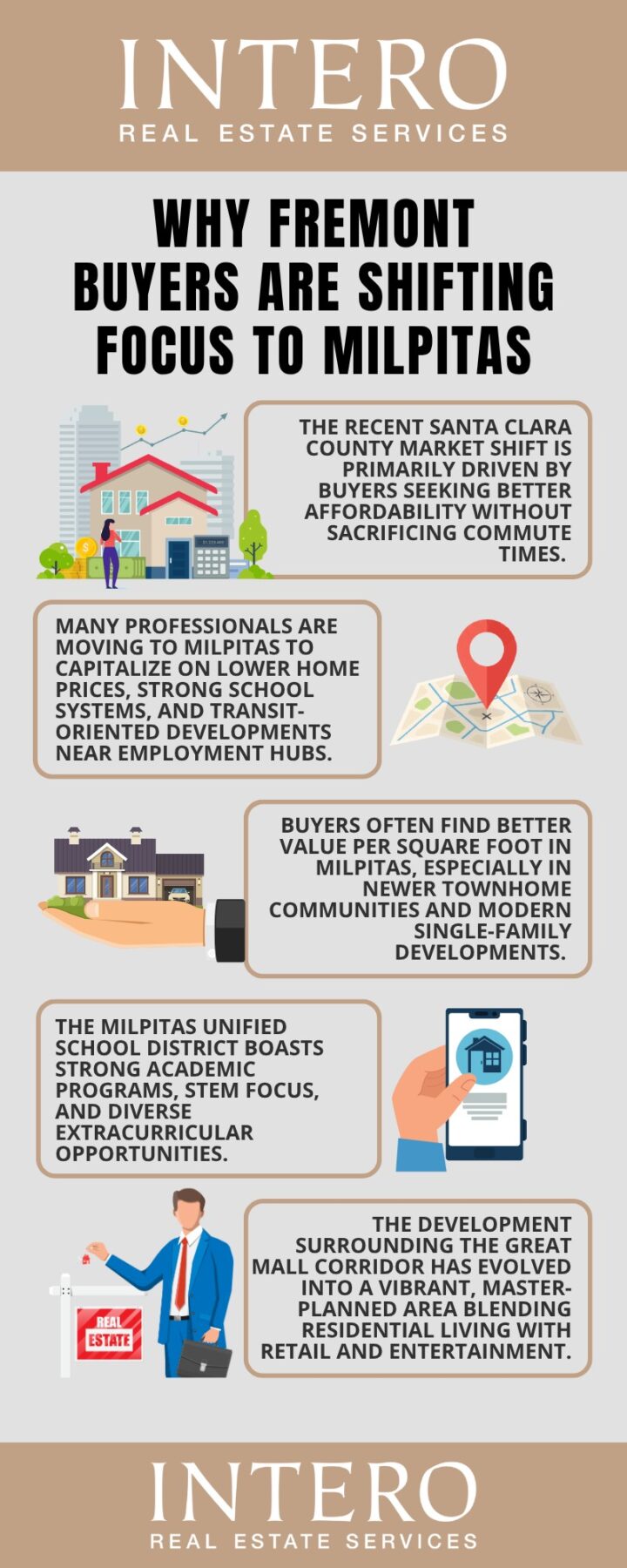
The recent Santa Clara County market shift is primarily driven by buyers seeking better affordability without sacrificing commute times. Many professionals are moving from Fremont to Milpitas to capitalize on slightly lower median home prices, strong school systems, and the rise of transit-oriented developments near major employment hubs.

Analyzing Milpitas vs Fremont Real Estate 2026
The Affordability Gap
When you break down Milpitas vs Fremont real estate 2026, the difference in pricing is one of the biggest motivators behind this shift.
Fremont remains firmly in the ultra-premium category, with many single-family homes pushing well beyond the reach of first-time and even some move-up buyers.
Milpitas, on the other hand, offers a slightly more accessible entry point. While still very much a premium market, buyers often find better value per square foot—especially in newer townhome communities and modern single-family developments.
This makes a real difference for buyers trying to balance mortgage payments with lifestyle goals.
In practical terms, that could mean the difference between settling for an older fixer in Fremont or securing a newer, move-in-ready home in Milpitas with upgraded amenities.

School District Excellence
One of the biggest concerns for families considering a move is education—and rightly so. Fremont has long been known for top-performing schools, particularly in areas like Mission San Jose.
However, the Milpitas Unified School District has made significant strides in recent years. Many schools in the district now perform competitively, offering strong academic programs, STEM focus, and diverse extracurricular opportunities.
For families weighing Milpitas vs Fremont real estate 2026, this is a key realization: crossing the city line doesn’t mean sacrificing educational quality. In fact, for many, it’s a strategic trade-off that still supports long-term family goals.
The Rise of Silicon Valley Transit-Oriented Homes
Modern Commuter Living
Today’s buyers—especially those working in tech—are thinking differently about how they live. It’s no longer just about square footage or lot size. Convenience, walkability, and access to transit have become top priorities.

That’s where Silicon Valley transit-oriented homes come into play. In Milpitas, newer developments are intentionally designed around lifestyle efficiency. Residents can walk from their homes to grocery stores, coffee shops, fitness centers, and transit hubs without needing to rely on a car for every errand.
This is a stark contrast to many older Fremont neighborhoods, where driving remains a daily necessity.
Master-Planned Convenience
One of the standout areas in Milpitas is the development surrounding the Great Mall corridor. This area has evolved into a vibrant, master-planned environment that blends residential living with retail and entertainment.
Buyers here are finding communities with resort-style amenities—think pools, clubhouses, landscaped courtyards, and even co-working spaces. These features are becoming increasingly attractive, particularly for younger professionals and hybrid workers.
For those comparing options, it’s easy to see why newer Milpitas communities feel more aligned with modern expectations than some of Fremont’s more established subdivisions.
Investing in BART Station Housing Milpitas
The Transit Hub Advantage
One of the most compelling reasons behind this shift is the rise of BART station housing Milpitas. The Milpitas Transit Center has become a major anchor for commuters, connecting BART, VTA Light Rail, and key freeway corridors.
For residents, this means a seamless, traffic-free commute into San Jose, or even up the peninsula toward San Francisco. Instead of spending hours behind the wheel, many are opting for predictable, efficient transit options that improve overall quality of life.

Long-Term Appreciation
From an investment standpoint, properties located near transit hubs have consistently shown strong appreciation. In 2026, that trend continues.
Homes within walking distance of the Milpitas Transit Center are particularly attractive—not just for current buyers, but also for future resale value. As demand for transit-oriented living grows, these properties are positioned to remain highly desirable.
For buyers thinking long-term, BART station housing Milpitas offers both lifestyle benefits and financial upside.
Relocation Comparison Table
Here’s a quick side-by-side look to help buyers visualize the differences:
| Metric | Fremont | Milpitas |
|---|---|---|
| Median Home Price | Ultra-Premium ($$$$) | Premium ($$$) |
| Transit Options | BART, ACE, Highway 880 | BART, VTA Light Rail, Highway 237/880 |
| Housing Stock | Established / Older | Mix of Historic and High-Density New Build |
| Vibe | Sprawling Suburb | Emerging Urban-Suburban Hub |
Key Takeaway
Adapting to the Santa Clara County market shift doesn’t necessarily mean compromising—it often means looking just a few miles in a smarter direction.
When you evaluate Milpitas vs Fremont real estate 2026, the value proposition becomes clear. Buyers who are moving from Fremont to Milpitas are not stepping down—they’re stepping into a more balanced lifestyle.
With access to Silicon Valley transit-oriented homes, modern communities, and the long-term upside of BART station housing Milpitas, this shift represents a strategic move toward convenience, affordability, and future growth.
If you’re considering making the move or simply want to explore your options, having the right guidance makes all the difference. Whether you’re buying your first home or repositioning within the market, expert insight can help you make a confident decision.
Reach out today at (408) 946-2100 or email husain.realty@gmail.com to start a conversation about your next move.
Frequently Asked Questions
In many cases, yes. Milpitas offers more direct access to major employment hubs, especially via BART and VTA connections, reducing reliance on freeway traffic.
Property tax rates are generally similar, as both cities fall within California’s base property tax structure. However, newer developments in Milpitas may include additional assessments.
Areas near the Milpitas Transit Center and Great Mall are among the most sought-after due to their walkability and access to transit.
Milpitas stands out for newer townhome inventory, often featuring modern layouts and amenities, while Fremont’s supply tends to be older and more limited.
It can be challenging, but certain townhomes and condos near transit hubs may still fall within that range, depending on market conditions.
While Mission San Jose remains one of the top-performing areas, Milpitas schools are increasingly competitive and continue to improve year over year.
The Great Mall is a major retail hub, complemented by a growing number of restaurants, entertainment venues, and lifestyle amenities nearby.