
Silicon Valley Probate Real Estate Guide
Settling an estate in the Bay Area involves more than legal paperwork—it’s a process that blends financial strategy, property management, and careful timing.
In a region where real estate values are among the highest in the country, executors often find themselves responsible for decisions that can significantly impact an estate’s final outcome.
Across communities like tech-driven suburbs and long-established residential neighborhoods, probate real estate requires both procedural accuracy and market awareness.
From understanding timelines to preparing a property for sale, the right guidance can make the difference between a stressful experience and a well-managed transition.
This guide outlines how executors and heirs can approach estate property decisions with confidence, especially when working through the requirements of the Santa Clara County Superior Court and local market dynamics.
Whether you’re reviewing documents, preparing a home for sale, or coordinating with professionals, the framework below will help you navigate Silicon Valley probate real estate.
What Is the Probate Process in Silicon Valley?
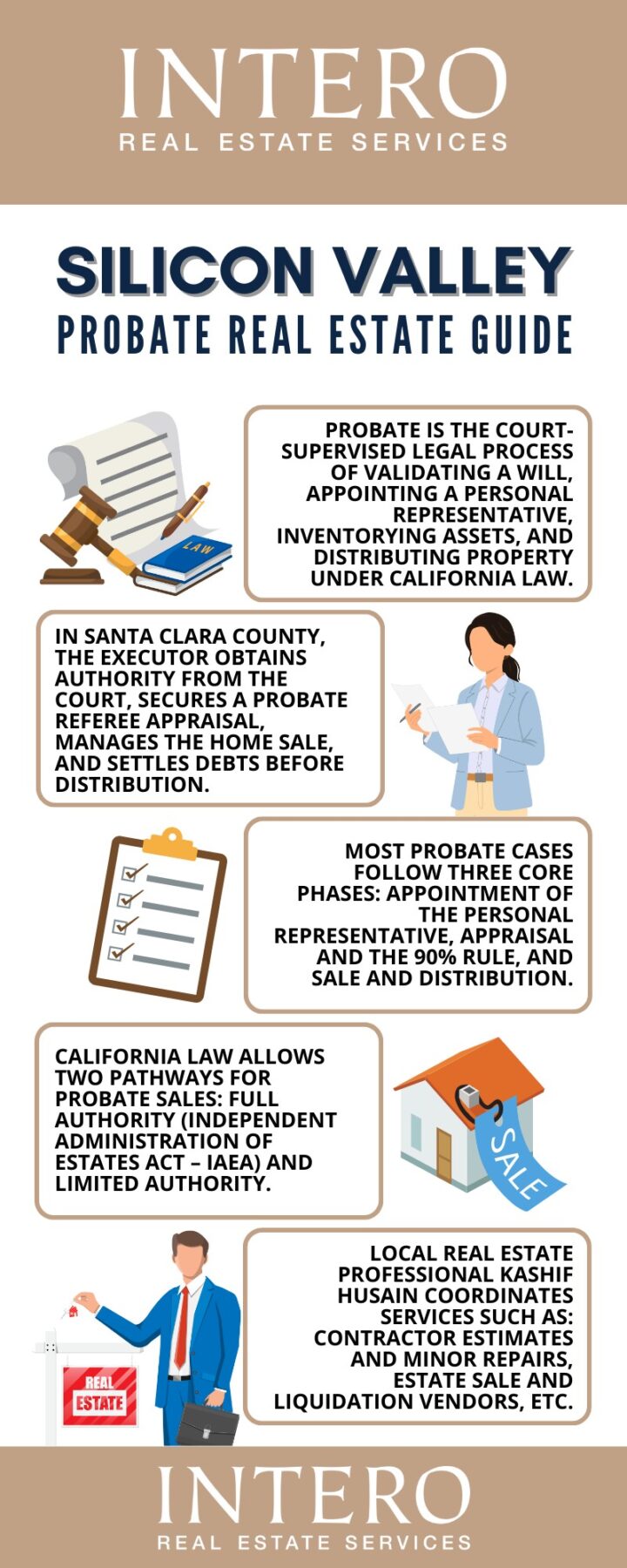
Probate in Silicon Valley is the court-supervised legal process of validating a will, appointing a personal representative, inventorying assets, and distributing property under California law.
In Santa Clara County, the executor obtains authority from the court, secures a Probate Referee appraisal, manages the home sale, and settles debts before distribution.
The process typically includes filing petitions, reviewing Santa Clara County probate records, coordinating property valuation, and ensuring compliance with probate Santa Clara County procedures before assets can be distributed.
For many estates, the home represents the largest asset, making the involvement of a knowledgeable probate realtor in Santa Clara County especially important.
Navigating the Santa Clara County Probate Timeline
While each estate differs, most probate cases follow three core phases.

1
Appointment of the Personal Representative
The court must first authorize someone to act on behalf of the estate. Letters Testamentary (when a will exists) and Letters of Administration (when there is no will) are official court documents granting legal authority to the executor or administrator.
Think of these as the “golden tickets”—they allow the representative to hire professionals, open estate accounts, and list the property for sale.
Without these documents, no binding real estate decisions can be made.
2
The Appraisal and the 90% Rule
Once authority is granted, the court assigns a Probate Referee to determine the fair market value of the property as of the date of death.
This valuation drives an important guideline known as the 90% Rule:
- A probate property generally cannot be sold for less than 90% of the appraised value without additional court approval.
- In shifting markets—common in Silicon Valley—pricing strategy becomes critical to avoid delays.
Executors often benefit from pairing the Probate Referee’s valuation with a local comparative market analysis to ensure pricing aligns with current demand.
3
Sale and Distribution
California law allows two pathways for probate sales:
Full Authority (Independent Administration of Estates Act – IAEA)
If granted, the executor can sell the property without prior court confirmation, following standard disclosure and notice procedures.
Limited Authority
The court must approve the sale through a confirmation hearing, where overbidding may occur in open court.
Full Authority typically shortens timelines and offers greater pricing flexibility.
Strategies for Local Heirs and Families
Silicon Valley markets vary dramatically by city, school district, and proximity to tech employers. Probate strategy should reflect these differences.
Milpitas and Sunnyvale Market Positioning
In communities like Milpitas and Sunnyvale, proximity to major employment centers and transit corridors strongly influences buyer demand.
Key probate strategies include:
- Highlight commuter access to tech campuses and highways
- Evaluate zoning or redevelopment potential for older homes
- Consider light cosmetic updates to maximize appeal without major investment
Properties near industrial or mixed-use corridors may attract investors or developers, especially when sold As-Is.
Cupertino and Mountain View: Premium School District Demand
In high-demand markets like Cupertino and Mountain View, estate homes are frequently purchased for land value or renovation potential.
Common trends include:
- Buyers targeting top-rated school districts
- Developers seeking rebuild opportunities
- Strong interest in original-condition homes sold As-Is
In these areas, even dated properties can command premium offers when priced strategically.
Property Preservation Checklist for Probate Homes
Vacant estate homes require active management during probate. Executors should prioritize:
- Securing doors, windows, and alarm systems
- Maintaining landscaping to meet city code requirements
- Forwarding mail and monitoring utilities
- Notifying insurance providers about vacancy status
- Scheduling periodic interior inspections
Proper maintenance protects value and prevents avoidable delays.
The Concierge Approach for Out-of-Area Heirs
For many families, especially those living outside the Bay Area, managing an estate property remotely can feel overwhelming.
Local real estate professional Kashif Husain coordinates services such as:
- Contractor estimates and minor repairs
- Estate sale and liquidation vendors
- Clean-out and debris removal crews
- Staging or marketing preparation
This turnkey approach reduces the executor’s workload while keeping the property market-ready.
Authority Comparison Table
| Feature | Full Authority (IAEA) | Limited Authority |
|---|---|---|
| Court Confirmation | Not Required | Required |
| Sale Speed | Fast (Standard Escrow) | Slower (Hearing Wait Times) |
| Overbidding | No (Unless Requested) | Yes (Open Court Auction) |
| Price Control | Executor Discretion | Subject to Court Minimums |
Understanding which authority applies helps determine pricing strategy and expected timelines.
Frequently Asked Questions
Yes. Most probate homes are sold As-Is. Sellers must still provide required disclosures, but repairs are not mandatory.
Typical timelines range from 4–9 months depending on court schedules, authority level, and property condition.
Fees are set by state law and are based on the gross value of the estate—not net equity. Both the attorney and executor receive statutory compensation.
Not necessarily. The executor has authority to act on behalf of the estate once appointed, although communication among heirs is strongly recommended.
Executors can search filings, forms, and hearing calendars through the court’s official probate division website.
Specialized Resources for Executors
Probate Checklist (Immediate Steps)
- Secure the property and change locks if necessary
- Notify homeowners insurance of vacancy
- Order multiple certified death certificates
- Locate mortgage and tax statements
- Interview probate real estate specialists
- Begin reviewing property valuation options
Local Contact Guide
Executors often benefit from building a small professional team early:
- Probate attorney familiar with California estate law
- Real estate professional specializing in probate sales
- Contractor or property maintenance vendors
- Local title company for preliminary reports
Reviewing property value early helps guide decisions about timing, repairs, and marketing strategy.
Legal Disclaimer
Kashif Husain is a licensed real estate professional and not an attorney. This guide is intended for informational purposes only and should not be considered legal advice. Executors should consult qualified legal counsel regarding estate-specific probate matters.
Navigating estate property decisions can feel complex, but with the right preparation and local expertise, executors can move forward with clarity and confidence.
From understanding court timelines to positioning a property in competitive tech-driven markets, strategic planning protects both value and family interests throughout the Silicon Valley probate real estate process.
If you’re navigating a probate sale in Silicon Valley and need clear, experienced guidance, call (408) 946-2100 or email husain.realty@gmail.com to schedule a consultation and get practical, local insight tailored to your probate situation.